How to validate a SaaS idea before you build anything
A practical validation sequence for founders: research the pain, test the pitch with a live landing page, and only build what strangers ask for.
The most expensive sentence in software is "I'll just build it and see."
It used to be expensive in engineering time. Now AI builders have made building nearly free — which, oddly, made the sentence more dangerous. When you can ship in an afternoon, the temptation is to skip the thinking entirely and validate by launching. Sometimes that works. Usually you've just built a very fast monument to an assumption nobody shared.
Here's the thing though: the same speed that tempts you to skip validation also makes validation itself dramatically cheaper. A live landing page used to be a week of work; now it's an evening. So the smart sequence in 2026 isn't "build less." It's "use the build speed on the test, not the product."
This is the sequence we recommend. It takes roughly a week of evenings, costs almost nothing, and ends with you knowing — not guessing — whether to build.
Step 1 — Write the one-paragraph pitch (30 minutes)
Before any research, force the idea into four sentences:
- Who is it for? (Specific. "Busy people" is not a who.)
- What pain does it remove? (A pain they'd say out loud, in their words.)
- What does it do about it? (One capability, not a feature list.)
- Why would they pay? (What does the pain cost them today — in money, hours, or embarrassment?)
If you can't fill in all four, you don't have an idea yet; you have a technology looking for a problem. That's fine — but it's a different exercise.
Keep this paragraph. It becomes your landing page copy in Step 3, and your build prompt in Step 5. Writing it once is the whole trick.
Step 2 — Check that the pain exists in the wild (one evening)
You're looking for evidence that strangers — not your friends — complain about this problem unprompted.
Where to look:
- Reddit and niche forums. Search the pain, not your solution. You want threads where people describe the problem in their own words. Save the exact phrases — they're marketing gold later.
- Reviews of adjacent tools. One- and two-star reviews of products near your space are a catalogue of unmet needs. If people repeatedly complain that Tool X is missing your idea, that's signal.
- "How do I…" searches. If people are asking search engines how to do the thing manually, they want it solved.
What you're scoring, honestly:
- Found 10+ unprompted complaints in different places? Strong signal, continue.
- Found a few, mostly old or lukewarm? Weak signal — sharpen the who and look again.
- Found nothing? Either the pain doesn't exist or the people who feel it don't write online. Both are warnings worth respecting.
A note on competition: finding competitors is good news at this stage. It means the pain is real enough that someone built a business on it. The question becomes whether a segment is underserved — too expensive, too complex, wrong audience — not whether the idea is "taken."
(If you want this step compressed: our free Kalit Search tool researches markets, competitors, pain points and pricing for an idea before you build — it's the same workflow, automated. And if you're at the "I don't even have an idea" stage, the free Idea Finder works the other direction.)
Step 3 — Put a live landing page in front of strangers (one evening)
Now the part that used to be the bottleneck.
Take your one-paragraph pitch and turn it into a real, published landing page: headline stating the outcome, three bullets on the pain it removes, and one form — "start your free trial" with a name and email field. This page is your experiment apparatus, so the form has to actually work; collecting interest is the entire point.
This is precisely the kind of build AI tools do well, and where speed matters: describe the page in a prompt (you already wrote the prompt — it's your Step 1 paragraph), publish it, and you have a live URL the same evening. With Kalit specifically, the form's backend exists by default and the page ships hardened, so your experiment isn't leaking the very emails it collects.
Two honest rules for the page:
- Don't oversell. Say what the product will do, not what it might someday do. You're testing the pitch you can deliver.
- Measure intent, not compliments. A signup with an email is intent. A "this is cool!" comment is a compliment. Only one of them validates.
Step 4 — Drive 100–200 of the right visitors (two or three evenings)
A landing page nobody visits proves nothing. You need a small, relevant audience:
- Post where you found the complaints in Step 2 — answer the thread, mention you're building exactly this, link the page. (Disclose it's yours. Communities forgive builders; they punish marketers.)
- Share it from your own accounts with the Step 1 paragraph as the post.
- If the niche has a newsletter or Discord, ask the owner what a small shout-out costs.
You're not launching. You're sampling. 100–200 targeted visitors is enough to read the signal.
How to read the results:
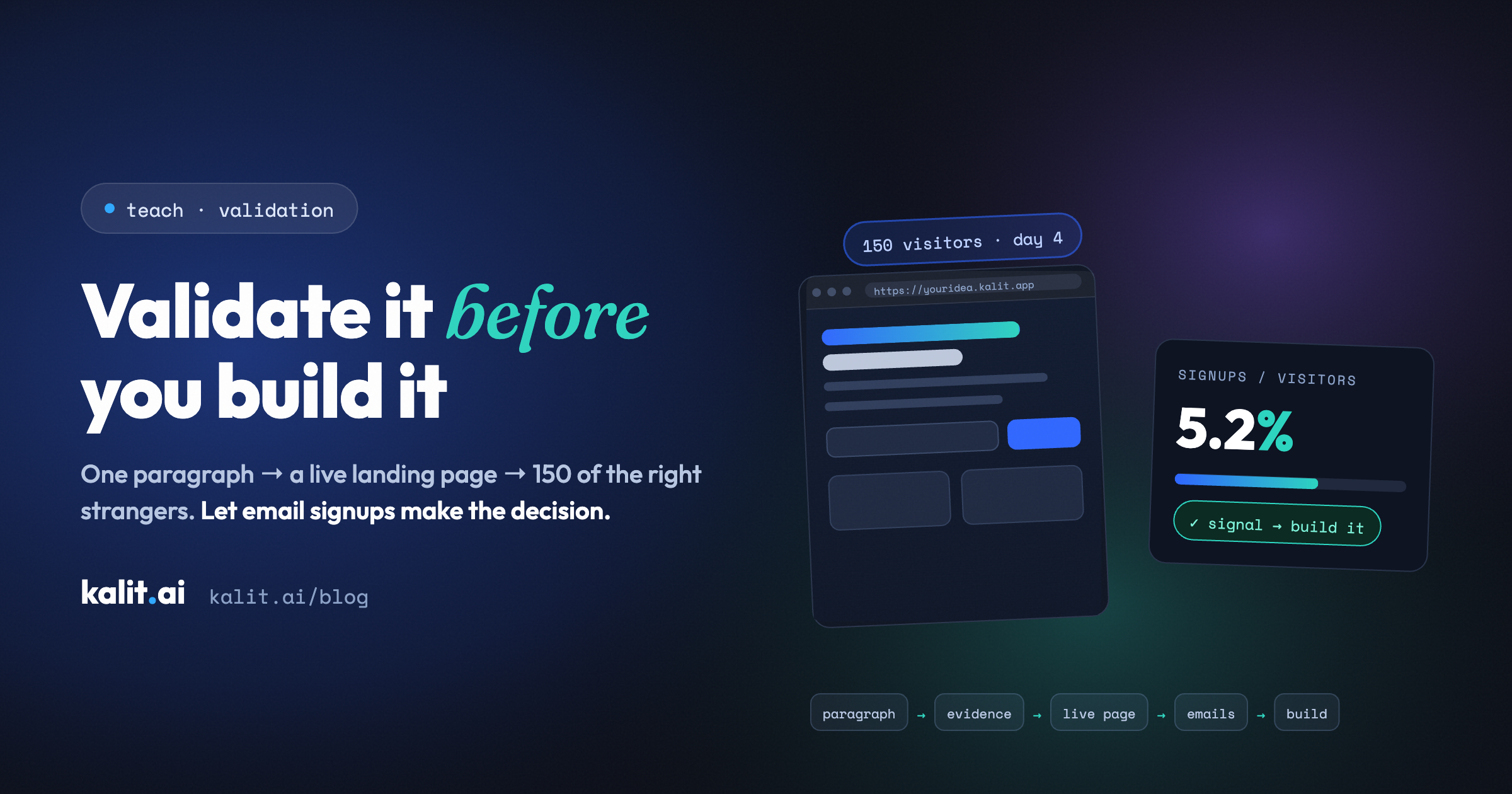
- 5%+ of visitors leave an email: strong. Real strangers traded contact info for a promise. Build.
- 2–5%: real but soft. Talk to the signups before deciding (Step 5 shortcut: just email them and ask what they hoped it would do).
- Under 2%: the pitch, the audience, or the pain is off. Revise one variable — usually the headline or the who — and run it again. The page takes minutes to change; that's the point.
Step 5 — Build the smallest thing the signups asked for
If the signal is there, now build — but build the conversation first. Email your signups one question: "What were you hoping this would do for you?" The replies will rank your feature list better than any roadmap session.
Then ship the one-feature version to those same people. You already have the prompt (Step 1), the copy (their words from Step 2), and an audience (Step 4's emails). The MVP's job isn't to impress; it's to be used by the twenty people who asked for it — live, on a real URL, collecting real usage you can learn from.
This is where the speed compounds: idea → research → live test → first users, in about a week of evenings, without writing code or committing a single weekend to an unvalidated build.
The sequence, on one line
Paragraph → evidence → live page → 150 visitors → emails → smallest build. Each step is cheap, each step can kill the idea, and an idea that survives all five deserves your effort.
The builders who get burned aren't the ones who build fast. They're the ones who build fast first and ask questions later. Flip the order and the same speed becomes your edge.
Put your idea's landing page live tonight → — describe it, publish it, and let strangers vote with their email addresses. Free to start. No code. No cliffs.
Related: How to launch an MVP without writing code · The 5 cliffs where people quit building with AI.